
JotWell: Private app for everyday money
For a long time, my money habit was simple: open Monito, enter what came in, enter what went out, move on. It was boring in the best way. I liked that it made me touch the numbers myself instead of pretending a sync had understood my life.
Then Monito started to feel abandoned. Updates slowed down, and I did not want a daily practice sitting inside an app that might never move again. I tried Fold Money and CRED Money too. Account Aggregator pulls data in, but I kept missing control: years of searchable history, categories I trusted, and entries I could read later without guessing what the app decided for me.
Building the replacement
That is where JotWell started. The first version stayed close to Monito's best part: open the current month, add inflow or outflow, pick a category, save, and see the total move. I left goals, alerts, and clever summaries out of the first pass.
Once that loop held, I added the parts that would make it safe to rely on: recurring items for repeated payments, backup and restore for moving phones, Trash for mistakes, widgets for quick checks, and stats for the month-end view.
Designing by running it
Because this was about a daily habit, I did not want to spend days designing screens outside the app. I skipped Figma and design-system setup, opened Codex inside the JotWell project, and kept the loop simple: prompt, build, check the phone-sized screen, fix.
The useful prompts sounded like moments from the day: add rent quickly, log groceries one-handed, keep suggestions beside the amount, keep the keyboard away from the form, keep dark mode readable at night.
That kept the design grounded. Thumb reach, density, contrast, keyboard space, scan speed. I kept naming the constraint, then fixed it in code.
The hard screens
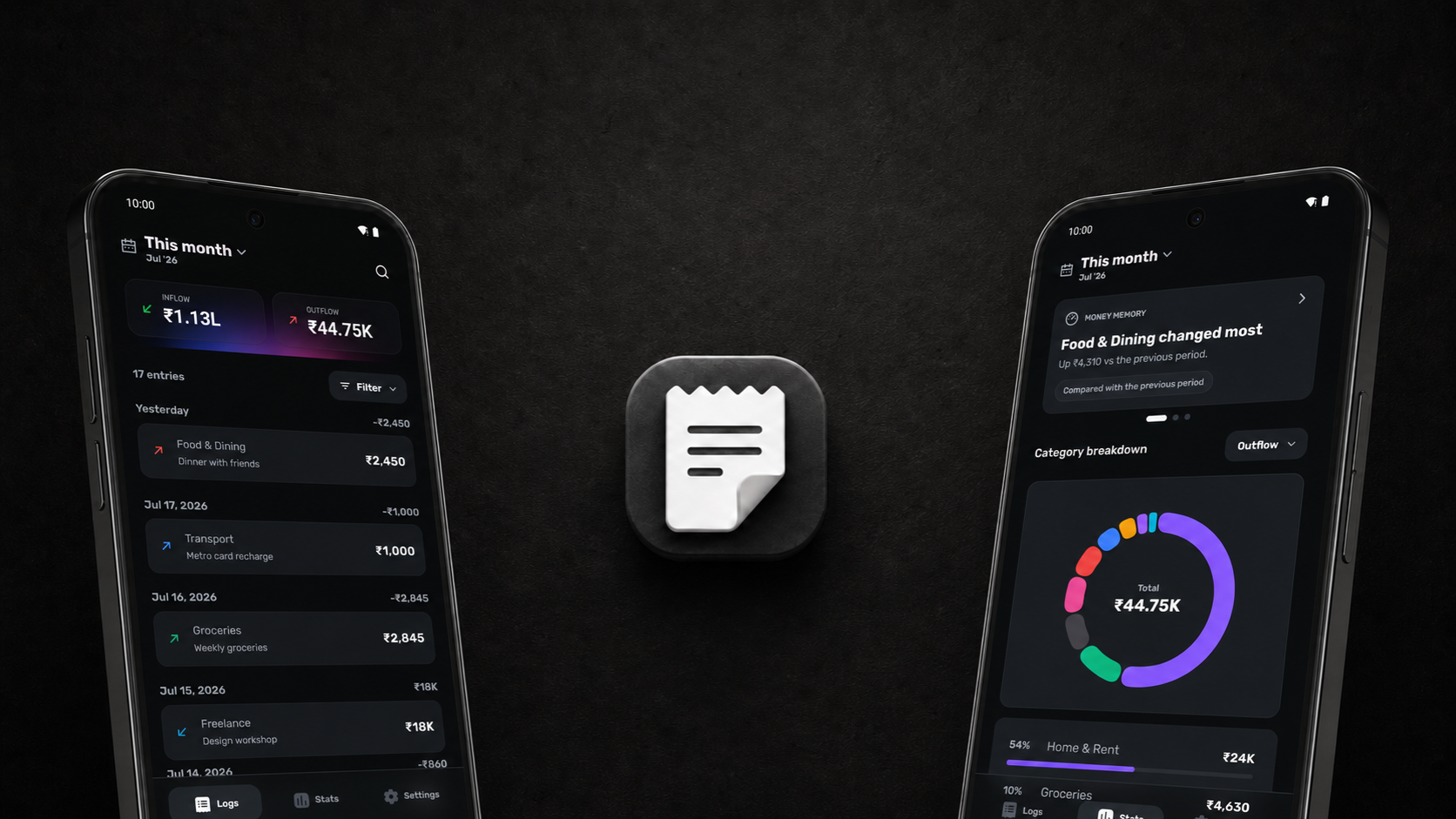
After the basic loop worked, the home log took over. It needed the month, inflow, outflow, entry list, filters, and add action on one screen without becoming a ledger wall. That screen carries the habit. If it feels heavy, manual entry becomes homework.
Stats was the next fight. A stats tab can become a quiet pile of charts. I wanted a reason to come back, so I kept it around questions I would ask myself: what changed this month, what is coming up, which category moved the most, and whether the period feels healthy.
Image carousel
JotWell Play Store screens
Five portrait screenshots from the published Play Store listing.
1 of 5: Private Money Ledger - The monthly log, totals, recent entries, and quick add action in one screen.
What Codex changed
Codex compressed the distance between an idea and a working screen. I could describe a flow, run the app build, try it, and ask for the next fix while the problem was still fresh. That speed mattered because the app was full of small judgement calls.
The same speed made mistakes cheap to create too. Codex hallucinated logic, made confident assumptions, broke state, and introduced crash-worthy bugs after harmless-looking changes. I had to run it, break it, read the code, fix the real path, and repeat.
Where it is today
JotWell now does what I wanted Monito to keep doing for me: daily ledger, quick manual entry, recurring items, categories, backups, widgets, and monthly stats. I kept it plain because I open it between things, not for a weekly finance ritual.
I still laugh at the timeline. Start date: May 24, 2026. Total Codex time: 24 hours 6 minutes. Total tokens: 745,105,342, including the repeated context Codex carried through the build.
I shipped JotWell to Google Play in June, and it is now available on the App Store too. SMS capture is tempting too, if I can keep it private and avoid a permissions mess.